Audi · EU monitoring data
Audi R8 Spyder: CO2 & EU registrations
3,344 new registrations on record, fleet-average CO2 from 315 g/km (WLTP, 2025). Official data reported by EU member states.
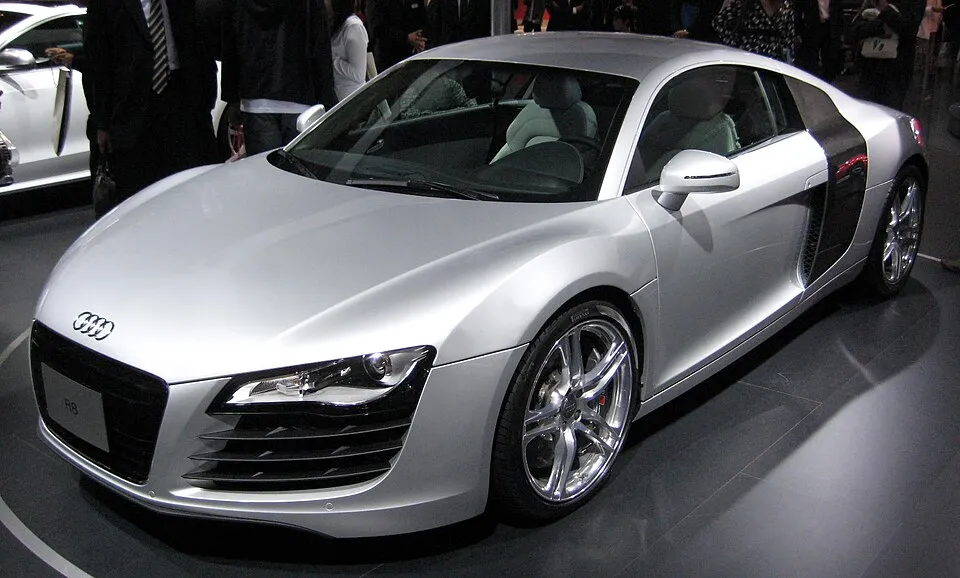
The Audi R8 is a mid-engine, 2-seater sports car, which uses Audi's trademark quattro permanent all-wheel drive system. It was introduced by the German car manufacturer Audi AG in 2006. Production ended in the first quarter of 2024.
By year and fuel type
Fleet averages across all Audi R8 Spyder registrations of that year and fuel. CO2 is WLTP where available (NEDC shown for older years). Consumption is l/100km for combustion, Wh/km for electric.
| Year | Fuel | Registrations | CO2 WLTP | CO2 NEDC | Consumption | Mass kg | Power kW |
|---|---|---|---|---|---|---|---|
| 2025 | Petrol | 21 | 315 g/km | - | 13.9 l/100km | 1,775 | 447 |
| 2024 | Petrol | 232 | 313.3 g/km | - | 13.8 l/100km | 1,771 | 438 |
| 2023 | Petrol | 190 | 313.5 g/km | - | 13.8 l/100km | 1,770 | 438 |
| 2022 | Petrol | 216 | 313.7 g/km | - | 13.8 l/100km | 1,771 | 439 |
| 2021 | Petrol | 267 | 313.9 g/km | - | 13.8 l/100km | 1,778 | 430 |
| 2020 | Petrol | 302 | 308 g/km | 301.7 g/km | - | 1,776 | 436 |
| 2019 | Petrol | 267 | 305.6 g/km | 300.9 g/km | - | 1,776 | 450 |
| 2018 | Petrol | 368 | - | 295.3 g/km | - | 1,773 | 426 |
| 2017 | Petrol | 529 | - | 280.1 g/km | - | 1,790 | 408 |
| 2016 | Petrol | 190 | - | - | - | 1,753 | 397 |
| 2015 | Petrol | 223 | - | - | - | 1,798 | 361 |
| 2014 | Petrol | 264 | - | - | - | 1,799 | 363 |
| 2013 | Petrol | 275 | - | - | - | 1,800 | 365 |
Frequently Asked Questions
What are the CO2 emissions of a Audi R8 Spyder?
Official EU monitoring data for 2025 registrations shows fleet-average CO2 from 315 g/km (WLTP) for the Audi R8 Spyder, varying by fuel type and configuration; the table on this page lists every year and fuel type.
How many Audi R8 Spyder are registered in the EU?
The EEA monitoring database records 3,344 new Audi R8 Spyder registrations in Europe between 2010 and 2025. These are new-car registrations reported by member states, not the number currently on the road.
Source: European Environment Agency, CO2 emissions from new passenger cars (Regulation (EU) 2019/631 monitoring), CC-BY 4.0, attribution EEA / DG CLIMA. Figures are fleet averages of new registrations, not per-vehicle values. Details on About & Data Sources.